Laser Lumbar Disc Surgery: Scientific Review, Benefits, Risks, and Who Is a Suitable Candidate
Laser lumbar disc surgery is a minimally invasive method for treating herniated discs that has gained significant attention in recent years. Many patients often ask:
"Can laser replace traditional lumbar disc surgery?"
The short answer:
Sometimes yes, but not for all patients.
In this article, we review in detail what laser lumbar disc surgery is, who is a suitable candidate, its benefits and limitations, and when it should not be used.
What is Laser Lumbar Disc Surgery?
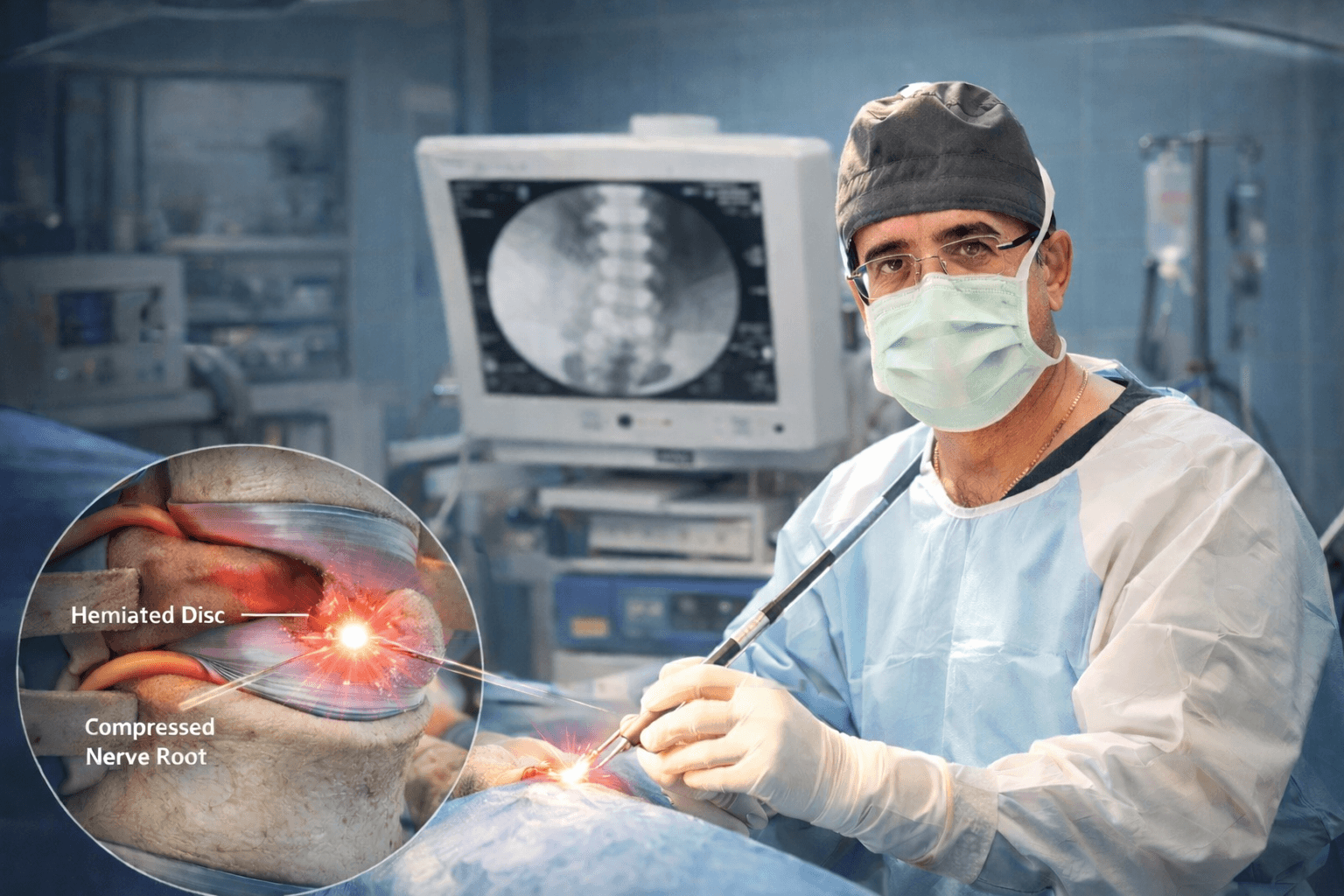
The scientific term for this procedure is Percutaneous Laser Disc Decompression (PLDD).
In this technique:
A thin needle is inserted into the disc under imaging guidance
A laser fiber passes through the needle
Part of the disc's gelatinous core is vaporized
Internal disc pressure is reduced
Pressure on the nerve root is relieved
Important: the disc is not removed; only its volume is reduced.
How Does Laser Reduce Sciatic Pain?
Sciatic pain occurs when a disc compresses a nerve.
Laser reduces internal disc volume, decreasing mechanical pressure. Even a few millimeters of reduction can clinically reduce leg pain significantly.
This method mainly affects internal disc pressure, not structural regeneration.
Who Is the Best Candidate for Laser Disc Surgery?
Success depends entirely on proper patient selection.
Suitable candidates generally have:
Mild to moderate disc herniation
Sciatic pain without severe muscle weakness
No severe spinal canal stenosis
No vertebral instability
No complete disc fragment separation
For large discs or cases with fully separated disc fragments, microscopic surgery is usually preferred.
Benefits of Laser Disc Surgery
No large surgical incision
Usually no general anesthesia required
Minimal damage to surrounding muscles
Short procedure time
Faster return to daily activities
However, minimally invasive does not mean suitable for everyone.
Possible Risks
Although considered safe, risks include:
Lack of treatment response
Recurrence of symptoms
Disc infection (rare)
Temporary nerve irritation
Accurate evaluation before surgery minimizes complications.
Laser vs. Microscopic Disc Surgery
Microscopic surgery removes the disc directly, while laser only reduces internal disc volume.
Microscopic surgery is preferred for:
Progressive muscle weakness
Severe pain resistant to treatment
Bladder or bowel control issues
Large discs with severe nerve compression
Treatment choice must be patient-specific, not advertisement-driven.
Is Laser Disc Surgery Permanent?
Laser reduces disc pressure but does not regenerate it. Core muscle strengthening and posture correction are essential to prevent recurrence.
Without addressing underlying factors, pain may return.
Key Factors for Success
Not the laser device.
Not advertisements.
But:
✔ Accurate diagnosis
✔ Proper patient selection
✔ Surgeon’s experience
✔ Postoperative follow-up and rehabilitation
In many cases, surgery or laser may not even be necessary; non-surgical treatments can be sufficient.
Conclusion
Laser lumbar disc surgery is minimally invasive and effective for selected patients. It is not an absolute substitute for surgery, but can provide satisfactory results for appropriate candidates.
The final decision should be based on a specialist examination, detailed MRI review, and complete neurological assessment.
If you suffer from back or sciatic pain, choosing the right treatment requires specialist evaluation, not only MRI images or advertisements.